





The protection and reuse of large industrial structures
Adaptive reuse works best on a broad scale, revitalising an entire neighbourhood or area, and promoting the circular economy by extending the life of buildings.

|
| Cottam Power Station in 2023 after the partial demolition of the turbine hall (Photo: Isaac Bee, Wikimedia). |
The Industrial Revolution that emerged in Britain in the late 18th century and spread across Europe and North America gave impetus to the development of infrastructure. Subsequent scientific discovery fuelled larger and increasingly more complex systems. From steam engines to national energy networks, and from gas to nuclear power, new technological building types and processes became ever more widespread. International ocean transport required deeper ports and taller cranes; road networks increased traffic demand with longer and more complicated bridges, viaducts, tunnels and flyovers; energy provision moved from localised gas supplies stored in gasometers to national grids; and coal-fired electricity provision with giant cooling towers is being replaced by offshore windfarms and nuclear power stations. The pressure to maintain a healthy economy, now accompanied by the need to reduce carbon dioxide and other greenhouse gas emissions, triggers the continued replacement or improvement of obsolete largescale infrastructure.
Do such structures have heritage value? When they are no longer used for their original purpose, what should their future be? While some may be symbolic of the communities to which they were attached, often they are regarded as detrimental to the character of the landscape. But, ironically, the re-use of these structures, which are generally high emitters of carbon dioxide in themselves, could be more sustainable than demolition. In essence, is sufficient consideration given to the protection and adaptive re-use of large engineering structures and, if so, how might they be successfully conserved?
In September 2021, the Dorman Long Coal Tower on the former Redcar Steelworks site in Teesside was blown up overnight, two days after the decision to list the building had been quashed by the newly appointed culture secretary, Nadine Dorris. Erected in the 1950s, the huge reinforced concrete tower stored 5,000 tons of coal and was described by Historic England in its short-lived listing description as ‘a rare surviving remnant of the coal, iron and steel industries, standing as a monument to Teesside’s, and England’s, 20th-century industrial heritage.’
Also controversial was the loss of the Ironbridge coal-fired power station with its four pink cooling towers, turbine hall and chimneys, which were demolished between 2017 and 2021. The Twentieth Century Society has called for the protection of cooling towers, described by artist Sir Anthony Gormley as ‘Man-made volcanos… a memorial to Britain’s great, 200-year-long romance with the second law of thermodynamics’. In the 1960s there were approximately 250 cooling towers across the UK, but with the rapid closure of coal-fired power stations this number has diminished to fewer than 30. Since a certificate of immunity from listing has been granted to all that remain, and the last coal-fired power station has recently been closed, it seems unlikely that any will survive. Such losses are likely to continue, but the growing interest in adaptive re-use of industrial structures and the need for sustainable development have resulted in some significant achievements.
The transformation of the Lingotto, the legendary Fiat Factory in Turin, was a pioneering venture. Built in 1917–23, demolition was never considered when the production line was moved to other sites in the 1960s and 70s. In the hands of Renzo Piano, a successful scheme for multi-use commercial and cultural activities, including the retention of the famous roof-top testing track, was completed in 1997. The conversion of the Bankside and Battersea Power Stations in London have shown how historic infrastructure can be a catalyst to large-scale regeneration, and recent projects in the UK and other European countries have used large historic structures as landmarks in environmental regeneration.
A prime example is the Kings Cross redevelopment programme, which has resulted in a network of public open spaces, streets, squares and parks providing connections with the wider city. Twenty historic buildings have been restored and given new uses, each one an integral element of the townscape. These include the three Grade II-listed gasholders that have been converted into apartments, and the neighbouring Coal Drops Yard, also Grade II listed, which is given over to retail, restaurants and cafes. The drums of the three gasholders dating from the 1860s have been adapted by architect WilkinsonEyre to stand at different heights, replicating the movement of the original holders, which rose and fell depending on the pressure of the gas within. The central space between the three frames forms an open courtyard, revealing the cast-iron structures at their point of intersection.
The coal drops consist of two long three-storey blocks, one built in 1851 and the other in 1860, as part of a system of distributing coal from Yorkshire and the north-east to the London market. Originally the structures carried high-level railway tracks from which waggons discharged coal into storage bins on the middle floor above cart-loading bays. Thomas Heatherwick’s adaptation ingeniously took the two converging sheds and connected them with the twisting ‘kissing roof’.
The Normandy U-boat bunkers, relics of the second world war Atlantic Wall, represent a very different building type, the epitome of brutalism before it gained its name. Built on five major sites in occupied France to accommodate 90 submarines, they were the largest structures erected by the Nazis outside Germany. With seven-metre-thick reinforced concrete roofs surmounted by concrete beams which acted as blast chambers, the buildings were virtually impregnable, and for that reason none has been demolished. The largest, Saint-Nazaire, with a length of 295 metres, stands as a monstrous barrier between the city and its harbour. Undaunted by its size and inflexibility, the municipality converted part of the structure into a cultural and music centre, with associated recording studios, bar and museum.
Recent development of Liverpool’s historic maritime infrastructure has focused attention on some of the challenges when dealing with large-scale heritage structures. Liverpool’s earliest surviving dockland formed a major element of the city’s world heritage site inscription, but the combination of an approved masterplan for Liverpool Waters, the north docks redevelopment which included tall buildings, and the proposal to build a new Everton Football stadium in the Bramley-Moore Dock, led to the world heritage status being revoked.
Whether this was a reasonable act is still a matter for debate, but since none of the proposed tall buildings have been erected and probably never will be, the issue rests principally on the impact that the stadium has had on the significance of the historic dockland. The physical impact is minimal since the listed dock walls and adjoining infrastructure have not been affected. Nor is the visual impact great, since the stadium is a surprisingly refined building, subservient to the nearby Stanley Dock Tobacco Warehouse, which is one of the primary heritage assets.
The replacement of the water in the dock with a large building changes the landscape character, but this has been the history of Liverpool’s docks for almost 200 years, with the Old Dock infilled to build the Customs House, the giant Tobacco Warehouse occupying a large part of the Stanley Dock, and the George’s Dock replaced by the magnificent Pier Head buildings, known as the Three Graces. Already the new stadium is acting as a major catalyst to the rejuvenation of the north docks, with many of the vacant historic buildings being converted to hotels, restaurants, bars, independent businesses and retail outlets, while conversion of the Tobacco Warehouse and other industrial buildings for residential use is progressing well.
Lessons can also be learned from the regeneration of the Ruhr Valley, Germany’s industrial centre, whose prosperity reached its zenith in the 1950s, followed by rapid decline, as John Pendlebury discusses on page 29. Since then, cities within the region have cooperated in transforming former industrial land and investing in green infrastructure to boost economic renewal and structural development. Within this, an EU-funded project has demonstrated how industrial heritage can be adapted to suit the environmental and economic concerns of the future. The coal mines closed in the 1980s, leaving filthy water and unbreathable air, but now the water bodies are safe for swimming, while Essen, the former industrial heart, has been named Europe’s Green Capital by the EU.
Most of the mines have gone, but when the Zollverein Coal Mine Industrial Complex closed in 1986, it was immediately bought by the State of North Rhine-Westphalia, which declared it a heritage site, accepting the obligation to preserve it in its original state and open it to the public. In 2001 it was inscribed as a Unesco world heritage site. During its working life, the Zollverein was the world’s largest coal mine, and the architectural quality of its buildings is high. The full infrastructure has been conserved: the pits, coking and coal-washing plants, railway lines, power station and boiler house, Dopplebock winding tower, which has become a symbol of the Ruhr’s industrial past, the pit heaps, miners’ housing, and consumer and welfare facilities. This has been achieved through reuse of the buildings for cultural activities, entertainment and tourism, implemented by the Zollverein Foundation. It includes two museums, the Ruhr Museum and the Red Dot Design Museum (the latter converted by Foster + Partners, with much of the original boiler-house equipment still in situ), a restaurant, open-air cinema, sports facilities and regular festivals.
The protection of Liverpool’s dockland, Germany’s Ruhr Valley and the King’s Cross project have all relied on a shift in perceptions relating to the socio-economic and environmental values inherent in historic places. Instead of treating monuments and groups of historic buildings as isolated objects, there has been a broader understanding of historic cities as places of habitation, where cultural objects are seen as elements of a wider human context that is constantly changing. Adaptive reuse works best on a broad scale, whereby an entire area or neighbourhood is revitalised. By extending the life of buildings, it also aligns with circular economic principles, which aim to minimise waste and keep resources in hand. This enhances resource efficiency by limiting the extraction of new materials while incorporating energy-saving upgrades to improve operational performance. As such, the long-term benefits are more likely to be economically sustainable, long lasting and cherished.
This article originally appeared in the Institute of Historic Building Conservation’s (IHBC’s) Context 186, published in September 2025. It was written by Peter de Figueiredo, the reviews editor of Context.
--Institute of Historic Building Conservation
[edit] Related articles on Designing Buildings Conservation.
IHBC NewsBlog
IHBC sponsors Gardens Trust event 23-4 Sept 2026
.jpeg)
'Learning from the Past, Shaping the Future’ takes place in Milton Keynes
Renovations to Frank Lloyd Wright's Fallingwater complete
.jpg)
World Heritage Preserved project opens house for tours again
Shakespeare Birthplace Trust places Hall's Croft on HAR Register
Stratford-upon-Avon home of Shakespeare's daughter is 'At Risk'
Lady Grange’s House repaired on St Kilda
.jpg)
National Trust for Scotland repairs stone cleit with link to famous island resident
Griff Rhys Jones on BBC Radio 4 Today programme
,_Green_Lane,_Derby.jpg)
The Victorian Society’s President unveiled its latest Top Ten Endangered Buildings 2026.
Need a MATE? Book your place now.

IHBC offers free webinars on applying for IHBC accreditation (Full & Associate).
UK Stained Glass Repository finds windows new homes
How are stained glass windows are rescued, stored and repurposed?
APPGEBE report sets high aims for quality
'Government must not sacrifice quality in drive to build 1.5m homes'
New measures protect Historic Shipwrecks from heritage crime

Underwater cultural heritage benefits from new HE guidance
How could the City of London skyline look in 6 years' time?

Visualisation shows approved planning applications as completed buildings
National Trust for Scotland calls for VAT cuts
Heritage neglect is encouraged by current policies
IHBC's 'Context' Issue 186 features Industrial Heritage
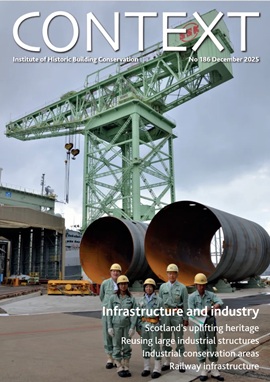
IHBC's members' journal reports on the challenges of conserving infrastructure
Book now for IHBC Annual School 2026
IHBC Annual School is taking place 18-20 June 2026 in Newcastle
RICHeS Research Infrastructure offers ‘Full Access Fund Call’
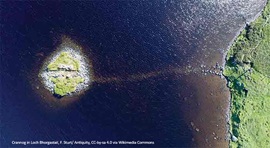
RICHeS offers a ‘Help’ webinar on 11 March
Latest IHBC Issue of Context features Roofing
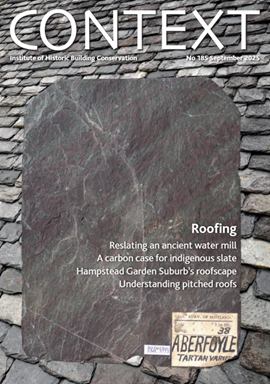
Articles range from slate to pitched roofs, and carbon impact to solar generation to roofscapes
Three reasons not to demolish Edinburgh’s Argyle House

Should 'Edinburgh's ugliest building' be saved?
IHBC’s 2025 Parliamentary Briefing...from Crafts in Crisis to Rubbish Retrofit
IHBC launches research-led ‘5 Commitments to Help Heritage Skills in Conservation’
How RDSAP 10.2 impacts EPC assessments in traditional buildings

Energy performance certificates (EPCs) tell us how energy efficient our buildings are, but the way these certificates are generated has changed.